
On the Scent
By Jessica Daly
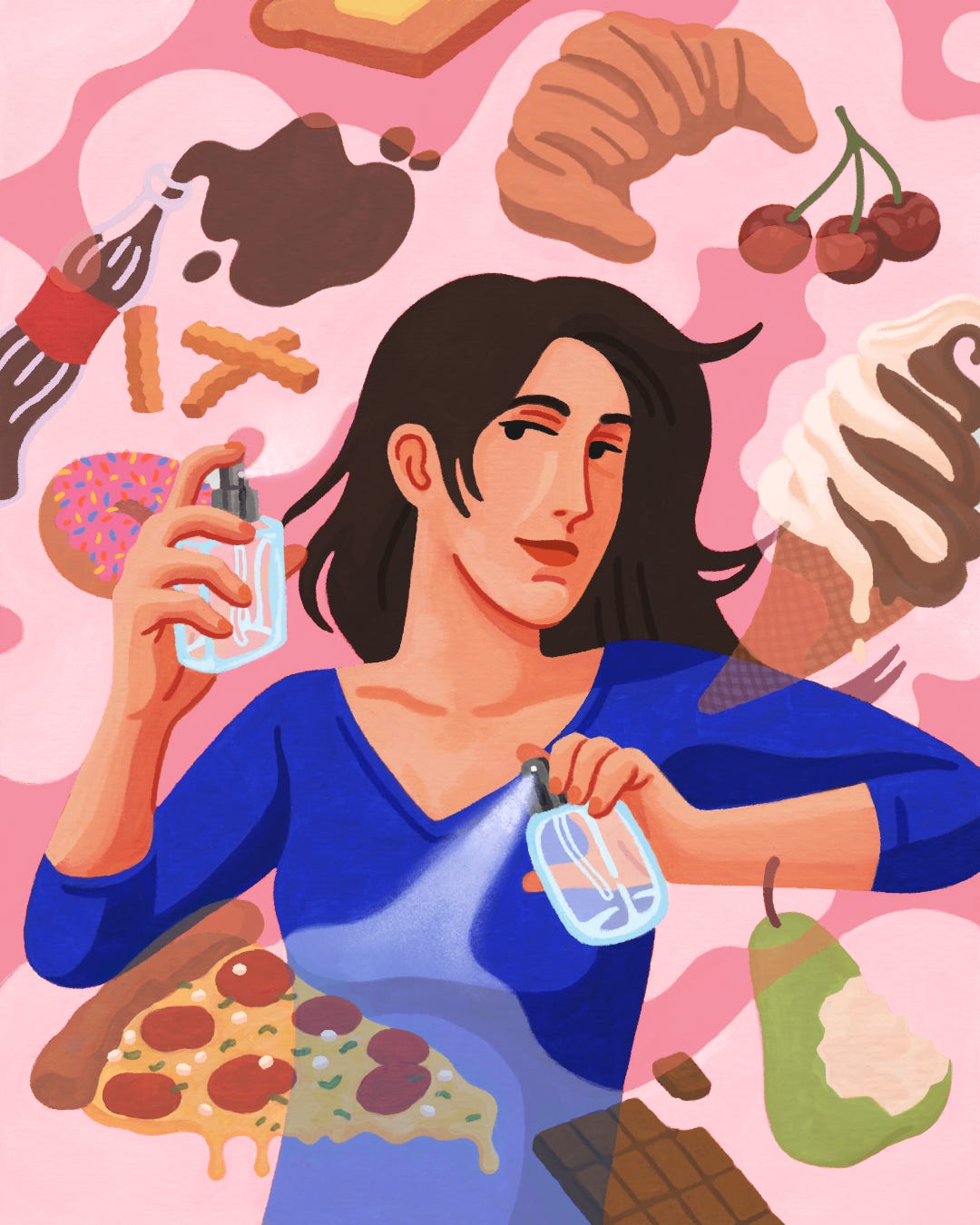
The first real perfume I ever owned, in the '90s, was Thierry Mugler’s Angel. I was in middle school and my mom and I agreed on it as an extra special birthday gift, my initiation into an experience of Macy’s sales counter adult femininity. The juice, as fragrance nerds obnoxiously call it, was Cinderella’s ball gown blue. And it came in an elegant, elongated star-shaped bottle – which felt both artistic and modern to me. Angel, in the '90s, smelled sweet and malted like delicately spun sugar. If it had a texture, it was fluffy, also effervescent. And in a certain way that was hard to pin down, it felt ethereal. This appealed to my 13-year-old senses. While I knew I liked sweet smells, I didn’t know at the time that I was in the presence of an original, the first of its kind. Angel, which came out in 1992, disrupted the fragrance industry by introducing an entirely new perfume category: The Gourmand. A gourmand perfume, simply put, is a fragrance that smells like food.
What’s remarkable and controversial about Angel is that, for a perfume that was sector-defining, by today’s standards, it barely smells like a food at all. Which speaks to how gourmands have evolved over the last three decades. However, its ingredient story is very much a gastronomical tale. Angel combines a patchouli base, as well as other notes like bergamot and mandarin, with a molecule called ethyl maltol, which smells – and also tastes like cotton candy. Ethyl maltol is literally edible¹ and master perfumers Olivier Cresp and Yves de Chirin, hired by Mugler to develop Angel, plucked it directly from the food industry, where it was used as an industrial flavoring ingredient. Today, if you’d like an illicit sniff of ethyl maltol, you can find it in a cotton candy vape cartridge.
To me, the beauty of a gourmand lies in the poetic dissonance between a food and its recreation. These perfumes don’t actually smell like the dishes they center on; they can’t. Instead, they evoke a platonic ideal – the avatar of a flavor or a food experience you carry in your mind. And this is not a failure but an artistic asset – much like how a painting can sometimes feel more emotionally resonant than a photograph of the same scene. A perfume evoking a food experience sands away the distracting edges of reality, creating something hyper-real. That said, gourmands exist on a spectrum – from fragrances that attempt to realistically recreate a food smell on one end, to compositions that merely gesture toward food as inspiration, on the other.
I first encountered Angels’ Share On The Rocks, by the brand Kilian², a perfume which beautifully explores this dissonance, on a winter loop around Saks Fifth Avenue. Angels’ Share is built around the idea of cognac and features the brand’s proprietary ‘On The Rocks’ accord, which is a brilliant artifact of fragrance science – a composition of molecules designed to mimic not just the olfactory, but also the physiological interaction a cold smell has with your nose if you, say, open a freezer and take a sniff. Angels’ Share, however, isn’t aiming to smell precisely like cognac, or even ice. Instead, it captures the imprint the idea of drinking a cognac might leave on your mind. To me, it smells like the idea of wearing a backless silk dress while an expensive drink in a rocks glass slowly condensates on a beautiful hotel bar, perhaps The Carlyle – which, as it happens, has its own purchasable fragrance, commissioned from New York perfumery DS & Durga.
On the more literal end of the spectrum is the perfumery Snif, known for creating accurate, ‘photorealistic’ gourmands. I had seen their pièce de résistance, Crumb Couture, lauded online in fragrance forums and on YouTube, as a croissant smell that flirted with the uncanny. And so I tracked it down, only to find myself immediately disappointed. On first spray, all I smelled was vanilla – a pleasant vanilla so generic it barely approximated pastry. However, as my wear-test continued, I began to notice an acute, sour yeast note that floated in and out of my olfactive perception. When the yeast hit, the molecules worked in concert to flood the searching, liminal space in my brain that asked croissant? And it answered firmly, yes. Fascinated by how this acrid, slightly unpleasant accord brought the composition to verisimilitude, I was impressed with Snif’s swing. I purchased their experimental gourmand sample set, The Secret Menu, which included the composition Soda Snob – a glass-bottle Coca-Cola scent that consumed my thoughts for months.
The experience of Soda Snob sent me on an existential ride. When I wore it, I felt kind of sophisticated. “You felt cool?” a friend asked me, surprised I was breaking ego fight club. Yes. I felt like I should be pairing Soda Snob with opaque sunglasses and my best jeans. It was confusing. I don’t especially like the taste of soda. And my associations with the smell of Coke, are if anything, that it’s vaguely childish. However, eventually, I worked out what I was reacting to. Thinking about Coca-Cola’s history, I realized the flavor underneath all the sugar in Coke is a fairly intense herbal accord – complex, bitter, not 100% user-friendly. Almost medieval and vaporous. Soda Snob reminds me of a European digestif. And this is not to say it doesn’t also smell exactly like soda. It holds at once both the tender imprint of an idea and the defined, structural components of its architecture.
During the summer of 2025, I spent some time in the Pacific Northwest, where I happened upon the excellent Portland ice cream franchise Salt & Straw. As I waited on a long ice cream line to get my scoop of strawberry-basil, I looked around at the shop and noticed a shelf holding, of all things, a perfume. The scent was Whiff of Waffle Cone, by Imaginary Authors – one of my favorite independent perfumeries. There was a little sign that noted Whiff of Waffle Cone was a collaboration with Salt & Straw. I had enjoyed, and even owned the perfume previously, but I had no idea that an ice cream parlor commissioned it, let alone the one I was currently standing in. As I neared the till, I spotted three additional Imaginary Authors fragrance bottles behind the food-area glass case itself. And when I inquired, an employee informed me these were edible sprays. For $.50 extra, I could have my ice cream finished with a scent. While under normal circumstances I would strongly advise against eating your perfume¹, this reminded me immediately of ethyl maltol, the edible Angel molecule that started it all.
I declined the spritz, which I regret to this day. Something about the moment gave me pause, and I vacillated on the decision to collapse the wall between food and perfume, ultimately deciding no. However, that wall has been coming down for thirty years – ever since Mugler crashed an industrial food factory and pulled from it borrowed molecules, redefining what a perfume was allowed to be. In the end, the collapse has a beautiful resonance – and the relationship between food and its atomized interpretation will continue to shimmer in and out through technology, memory, and fidelity, like a desert mirage. The croissant will taste like a perfume. The perfume will smell like a croissant.
And I will have to go back.
¹ Ethyl maltol molecules aside, please do not drink your perfume. It’s deliberately designed to poison you. Perfume uses denatured alcohol as its base, which is regular ethanol (the same kind you’d find in drinks) processed with additives that render it toxic. Why would a company do this? To avoid paying consumable alcohol tax.
² The brand Kilian is named after its founder, Kilian Hennessy – heir to the eponymous Hennessy spirits fortune. It seems right to have a masterfully boozy scent at the center of his line.
Jessica Daly is an art director, and creative multi-hyphenate with a very strong sense of smell. She’s interested in all things sensorial.
Read Jessica’s other Gullet stories:
Claire Wyman (she/they) is an illustrator and educator in New York City. She has created illustrations for a number of publications. Her work is inspired by the vibrancy of the city and of nature. Aside from her work as an illustrator, she has also been an arts educator, a cartoonist, and an editor. She has a BFA in Illustration from the Rhode Island School of Design. She is a visual storyteller at heart and is always looking for a new adventure.
See Claire’s previous Gullet illustration: