
A Lemon Doesn't Greet You
By Matt Bailey
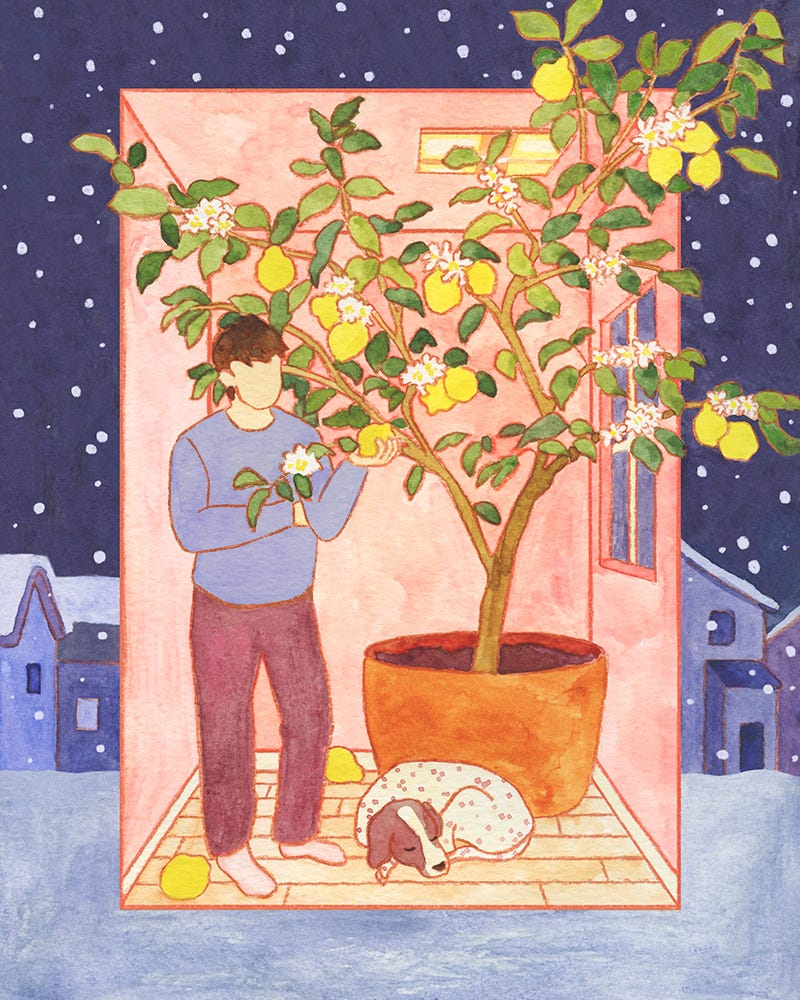
There’s a lemon tree in my life. I grew it from a cutting a friend gave me on the sidewalk more than a decade ago. I remember it poking two of its three little leaves out of the rumpled sandwich bag, its end swaddled in a wet paper towel. And now it’s immense.
Since that first summer I’ve carried, then dragged it outdoors after the last frost and back inside before winter, a ritual that, as it kept growing, looked more and more like I was going to end up in a back brace, and it in the wood chipper. Or volunteered for a viking funeral. A couple years ago, I hit my limit. That September, I’d just finished dragging the godforsaken thing indoors, and in my memory I’m standing there, sweating profusely, decorated by a few nice cat scratches and puncture wounds from its thorns, staring up at it where it brushes the twelve foot ceiling. And I look over my shoulder at the regular, human-sized door I just somehow wrestled it through, and the undeniable drag marks it has left across the hardwood floor. I contemplate just how much more this tree and its terracotta pot weigh than I do. And I say, “Jesus. I’m not doing that again,” and lay down with the dog on the floor. Staring up at the leaves and branches, I immediately started fretting about how it would get on without real sun.
The neighbors must think we’re growing weed. I’ve ordered these incredibly bright grow lights that are clearly meant for the kind of operation that’s hard to spot from a plane, and put them on a timer. The tree, glutton that it is, can’t help itself and is continuously growing too close to the lights and singeing its leaves.
So there it sits, looming ever-larger over the poor under-watered spider plants and their hail mary offshoots, over the dining room table, over the dog dish. Over me in the morning as I wince by to get my coffee, just praying that its klieg lights don’t turn on. Over me in the afternoon when I rush by for a snack between meetings. Over me when I adjust the thermostat before heading to bed. Over me when I water it, and when I reach up into the spiny lattice of it to pluck out a dead leaf and brush my fingers along its bark.
It’s beautiful. All trees are beautiful in the same way that all dogs are good, and all cats are Manson-esque cult leaders. But what I’m trying to get to is not so much its beauty but its heaviness, its obdurance, its irrefutability. This tree that I’ve been known to anthropomorphize, swear and mutter at, side eye, adore, name, rename, pet, chide, mist by hand for entirely sentimental reasons, and so on: When it comes down to it, this tree makes itself known to me, makes itself part of my life, simply by going nowhere, heavily, sometimes lushly, sometimes secretly, but always in its own slow cadences and slow, insistent quietude. Its moods gather slowly, invisible with its roots under the surface, and then one day reveal themselves in purple clutches of new growth, tiny hair’s breadth leaves that unfurl and stretch themselves out in every direction over the course of weeks, turning bright green and extending at the ends of new, equally bright branches, slowly twisting their faces towards the light. Or in purple buds that start smaller than match heads, then swell, whitening, and elongate into soft cylinders, before splitting and spreading open into delicate white-fingered flowers with long white stamens dotted at the end in pollen exactly the neon buttercream yellow of the fruit they’ll become.
Or its moods can be petulant and brooding. The sudden and very alarming leaf drops in protest of insufficient watering, or too much watering, or undetectable shifts in the barometer, or God-knows-what. The long sullen silences it will sit in, pouting, branches half bare, for months, before all of a sudden erupting in growth and pollen and exuberance. And we won’t even get into its feelings about sugar ants, dust mites, or scales. I’ve spent a decade now trying to learn how to read this lemon tree’s body language, its facial expressions. Trying to learn what it’s asking for, what it needs but feels it shouldn’t have to ask for, and what parts of its life, quite frankly, have nothing to do with me. What I can give it and what I can’t. For example, it really would like to insist on three pitchers of water every other day – consistency my bag-of-guppies brain will simply never be able to deliver. But I can fight off its infestations. I can prune its branches where they grow crosswise. I can turn its light up bright enough that it makes me want to wear a hat indoors.
I study it, I attend to it. Or, if you prefer, it trains me. Or, if you prefer, we converse. I think that’s why it glows for me, why it shimmers in my mind, the way a loved one does when you see them in a crowd. Why it shows up in my dreams. It’s an almost-solvable cipher. A running dialogue in a foreign language I’m learning by immersion. It’s the aliens in Arrival. I stand furrowed at its base, a warm mug in my hands, reading its polyrhythms with my eyes, feeling the way it bends my neck back to take them in, tilts my head for another vantage, makes me open my mouth to pull its smells across my tongue. I feel the compelling, fecund power of this gargantuan significant other in my life.
It’s been a tough year. Even correcting, if possible, for the chemical burns that the powers that be are giving all of our hearts. It’s been lose-my-way-in-life tough. It’s been voicemails from friends in crisis, in jail, in voluntary facilities tough. Can’t sleep and can’t wake up tough. It’s been dead Dad tough. After months of losing his mind, crying and talking in a baby voice, thinking he’s back in kindergarten, but taking notes every phone call, trying to preserve his own dignity and freedom. Pick your battles and remember to bathe, convince him to sign the forms, get a lawyer, wait out probate tough. Clean out his dresser with my brother tough.
For some reason the lemon tree loves to bloom in winter. This year, the buds were just on the cusp of opening when I flew out to Seattle for the holidays. I remember it as an overlay, on my time out there. Sorting through his house and wondering if they might be blooming for our friend who was dogsitting for us, and what a thing that would be to share with her. And sure enough, the blooms were still rolling open in waves when I came home two weeks later. The lush verdancy of them slid out around the doorframe into the cold, dry air as I turned the key to come inside. A tree doesn’t greet you like a dog does. That smell was a response to a call I didn’t know I’d placed, a second story pulling me from the maw of the first, notes scribbled down for me on a notepad other than Loss.
The price of that second story is patience. The first year the tree was mature enough to flower, I had no idea what to expect. The little green knobs that would grow into fruit displaced the tired browning petals, which tumbled to the floor and pooled there stickily, and the fruit grew, and grew, and grew. Now, I know this isn’t a true lemon tree at all but a “ponderosa lemon,” an accidental hybrid of citron and pomelo. But at the time I was in suspense. The lemons kept getting bigger and bigger over months and months but not yellowing. I watched and wondered how I’d know when they were ready. When they finally were, the better part of a year on, I plucked a huge round fruit, the size of a grapefruit, lemon yellow and weighty, from its branch, which sprang up to its natural position like a wild animal that had long plotted escape.
The fruit is alien but familiar. Lift it to your face and smell, unmistakably, lemon. Sweeter and more floral than a Meyer, but lemon nonetheless. Slice through the thick, bumpy, scabrous rind with a paring knife and pry it open with your fingers like an orange, essential oils spreading luxuriously, almost excessively, across your hands. It bursts with juice and the membranes between the segments are a little too thick, too insistent you not just ignore them. Lemon zesters quail before its Paleolithic rind, so use a cheese grater instead. This lemon is all knees and elbows but irresistible, fragrant, oily, un-shippable and therefore unsaleable and unknown, but unbothered and undeniable. Its hardy seeds have already sprouted tails and gather like tadpoles, demanding to be planted, already trees in their hearts. Forget whatever you were thinking about, captured by the smell, the touch, the sight, the actuality of it.
The irony here is I’m not all that passionate about lemons. How many two-pound lemons can a person eat in a year? How many friends really want a seedling? They’ve seen what happens. At the moment there are half a dozen almost ripe and maybe four dozen young fruit on that tree. And, my God, is it blooming again? But still the lemon tree, slowly, insists. And I wait, and watch, and water, and grieve, and fertilize, and prune. They’re painting our dad’s lemon-yellow house Realtor Gray next week. And then we can finally sell it and move on, maybe. I think I might pickle this batch, once it’s ready. But none of that yet. You learn ways to wait.
Matt Bailey is an writer, artist, and organizer from DC and Seattle. His writing has appeared in Hyperallergic, Slate, and elsewhere. His comics have appeared in alarmingly disreputable zines.
He’d like to remind you that there is truth and beauty in the world, as well as microplastics.
Laurie Perng is an illustrator and designer based in Brooklyn, New York. She enjoys capturing slice-of-life moments that make the everyday feel delightful. Her work has been recognized by the Society of Illustrators, American Illustration, and Communication Arts.
Such a beautiful essay! Thank you for this, Matt.
You will have to meet my Brugmansia in Ipswich.